Precision engineering for demanding UAV operations



UAV Generator Cost Analysis: Comparing Fuel, Maintenance, and Battery Replacement
Long-term power cost for an unmanned aerial vehicle operation is shaped by the energy path chosen at the ground: a fuel-driven generator, a battery bank charged from site power, or a hybrid arrangement that uses both. The purchase order may show a clear equipment price, yet the operating budget is usually determined by fuel burn at partial load, service intervals, battery aging, transport constraints, and the cost of an interruption during charging or launch preparation.
A useful comparison starts with the actual duty cycle. A generator rated for a high peak load can look inexpensive per kilowatt at purchase, but it may run inefficiently when only charging a small set of flight batteries. Conversely, a battery energy storage unit may have no direct fuel bill at the deployment site, while its replacement reserve becomes material after repeated deep cycles, high-temperature storage, or fast charging. The correct cost model should therefore use delivered usable energy and required availability, rather than nameplate power alone.
Set the Cost Boundary Before Comparing Equipment
Define the period of analysis, the required operating hours, the number of charging events, and the power demanded by chargers, communications equipment, lighting, cooling, and support tools. A field operation rarely draws a perfectly steady load. High-power chargers may create brief demand peaks, then fall sharply as battery packs approach full charge. Those changing loads influence generator fuel efficiency, cable sizing, inverter selection, and the practical output available at ambient temperature.
The cost boundary should include delivered fuel, consumable parts, scheduled labor, unscheduled repair exposure, transport preparation, replacement batteries, and end-of-life handling where applicable. It should also distinguish between energy used for flight batteries and energy lost in conversion. Generator alternator losses, charger efficiency, AC/DC conversion, battery round-trip losses, and idle consumption can produce a meaningful gap between fuel purchased and energy actually stored in an aircraft battery.
For a portable installation, logistics belongs in the calculation. Fuel containers, spill-control materials, lifting equipment, protective cases, ventilation provisions, and certified transport packaging may add recurring handling time. Battery-based systems introduce their own logistics: protected storage, state-of-charge management during transit, thermal protection, and pack isolation after damage or abnormal temperature events.
Fuel Cost Depends on Loading, Not Rated Output
Fuel consumption is often estimated from the generator's maximum output rating. That approach can distort cost substantially. Internal-combustion engines have a fuel-use curve that varies with load, speed, temperature, elevation, and maintenance condition. A conventional fixed-speed unit running far below its efficient range may consume fuel steadily even when charger demand is low. An inverter generator or electronically governed engine can reduce this penalty, but actual performance still depends on the connected load profile.
Build the fuel estimate from operating states rather than a single hourly assumption. Separate start-up and warm-up, active charging, standby, overnight auxiliary loads, and shutdown periods. Where chargers cycle or taper, record the average AC input demand over a representative charge event. If the site requires redundancy, include periodic test running of the reserve unit. A backup generator that is maintained but seldom loaded still consumes fuel during functional checks and may require fuel turnover to prevent degradation.
Fuel quality also affects cost beyond the invoice line. Diesel held too long can accumulate water or microbial contamination; gasoline can lose volatility; and contaminated fuel may clog filters, damage injectors, or create intermittent engine behavior. Filtration, water separation, approved containers, rotation records, and disposal of unusable stock should be treated as routine operating inputs. In remote deployments, freight, local availability, and restricted delivery windows can matter more than the nominal fuel price.
Generator sizing deserves close attention. A unit should accommodate charger inrush, concurrent equipment loads, expected derating, and a reserve margin without spending most of its time at an unnecessarily low load. Oversizing can raise capital cost, weight, noise, and low-load fuel use. Undersizing can cause voltage drop, frequency instability, nuisance protection trips, or slow charging. The required margin depends on the generator control system and the input behavior of the chargers, so published charger wattage alone may not be enough.
Maintenance Is a Scheduled Cost, but Downtime Is Often the Larger Exposure
Fuel-powered equipment carries a predictable maintenance schedule. Typical items include engine oil, oil filters, air filters, fuel filters, spark plugs on gasoline engines, coolant where fitted, belts, starter batteries, and inspection of mounts, hoses, exhaust components, and electrical connections. The exact interval must follow the engine and alternator documentation, especially where dusty air, heat, vibration, salt exposure, or prolonged idling applies.
Labor should be modeled realistically. A service event may require a cooldown period, spill prevention, waste-oil collection, access to consumables, and a functional run after reassembly. In a controlled workshop this is straightforward. At a temporary site, service time can expand because of poor access, limited lighting, weather protection, or the need to keep a second power source available. A maintenance plan that assumes every service can occur without interrupting charging can understate the true operational cost.
Some failures are inexpensive in parts but expensive in timing. A blocked fuel filter, corroded connector, weak starter battery, damaged recoil mechanism, or failed voltage regulator can stop a deployment until the fault is isolated. Keeping critical service parts on site reduces response time, but ties up inventory and requires control over storage life. For essential operations, the cost model should include either standby capacity or an accepted downtime allowance. Treating a single generator as permanently available without a contingency creates an optimistic result.
Generator maintenance also includes power-quality verification. Chargers and sensitive electronics may tolerate a broad input range, yet waveform distortion, unstable frequency, poor grounding, or voltage excursions can affect charge time, trigger faults, or shorten component life. Periodic inspection should cover output voltage under realistic load, protective earth continuity where required by the installation, cable insulation, plug condition, and strain relief. A low-cost generator becomes costly when it repeatedly creates hard-to-diagnose charging interruptions.
Battery Replacement Cost Is Driven by Usable Life
Battery systems move spending from daily fuel purchases to an upfront asset with a finite useful life. The replacement calculation should not use calendar age alone. Relevant factors include cycle count, depth of discharge, charge rate, storage temperature, time spent at high state of charge, discharge current, balancing performance, and protection-system behavior. A pack operated gently in a temperature-controlled environment can retain useful capacity longer than the same chemistry exposed to deep cycling and heat, but a budget should not assume ideal handling without evidence from the intended duty cycle.
Usable capacity matters more than nominal capacity. A battery bank may be rated at a stated energy value, while the inverter low-voltage cutoff, reserve requirement, degradation allowance, and temperature-related capacity reduction leave a smaller operational amount. The same principle applies to aircraft batteries: charging infrastructure needs enough stored energy to meet the required charging window after conversion losses and without repeatedly forcing the stationary bank to an aggressive depth of discharge.
Replacement planning should include more than cells or modules. Depending on the architecture, costs may arise from battery management electronics, contactors, fuses, cooling fans or plates, enclosure seals, connectors, and commissioning tests after pack replacement. Modular systems may allow a defective module to be isolated, but module matching can become important when older and newer units operate in parallel. Large differences in internal resistance or capacity may limit overall performance and complicate balancing.
Storage policy has direct financial value. Leaving lithium-based packs fully charged in high ambient temperatures, allowing a pack to remain deeply discharged, or charging outside the supplier's permitted temperature range can accelerate degradation or create safety restrictions. A documented receiving inspection, periodic state-of-charge review, and controlled quarantine process for swollen, damaged, or overheated packs are operating requirements, not administrative extras.
Compare the Energy Paths on the Same Basis
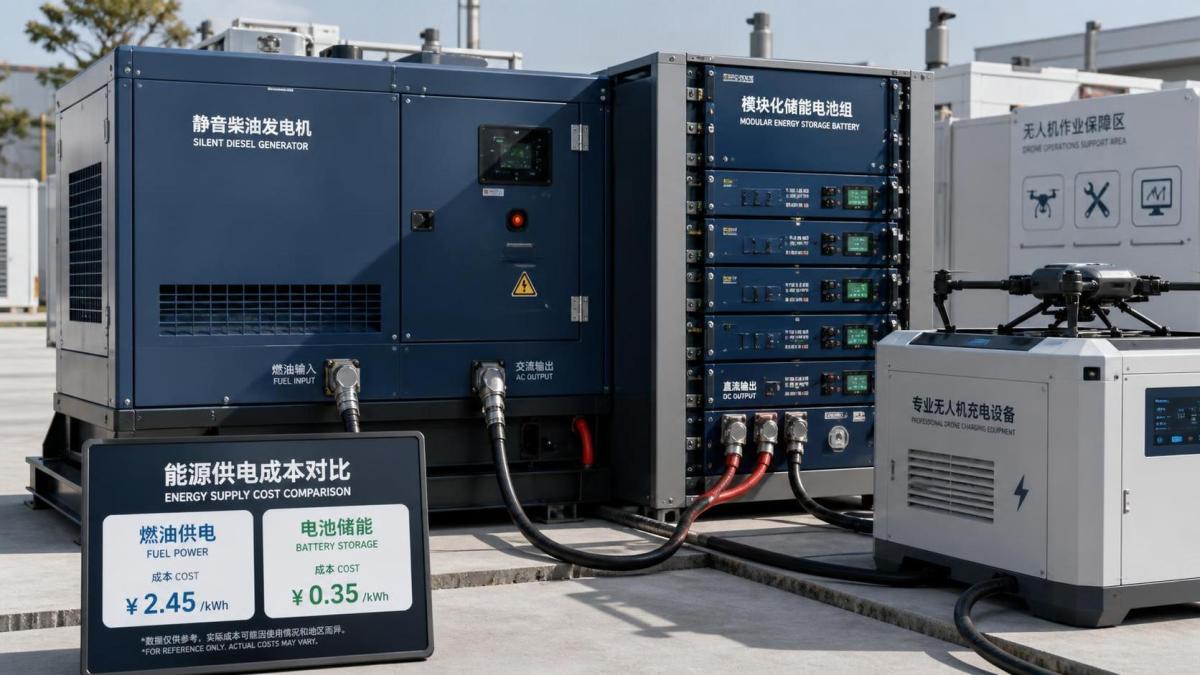
A practical model converts each option into cost per usable kilowatt-hour delivered to the charging equipment, then adds availability-related costs separately. For fuel generation, begin with fuel consumption at the measured load, include fuel delivery and consumables, then account for generator maintenance and expected service labor. Divide the resulting cost by energy available after generator and charger losses.
For a battery energy storage arrangement, spread the installed battery and balance-of-system cost across expected usable lifetime energy. Add charging electricity, inverter losses, scheduled inspection, thermal management energy if present, and replacement components. The lifetime-energy denominator should be conservative enough to reflect the planned depth of discharge and permitted operating temperature, rather than assuming every rated cycle produces full nominal capacity.
A hybrid arrangement can reduce exposure on both sides when configured for the load profile. The generator can operate during efficient charging windows, while the stationary battery supplies low loads, short peaks, and quiet periods. This may reduce engine idle hours and generator starts. It also introduces control logic, additional conversion equipment, and another maintenance domain. Savings should only be credited after confirming that the control system prevents simultaneous inefficient charging and discharging under normal operation.
Installation Details Can Change the Result
Electrical distribution should be sized for continuous load, peak demand, cable length, voltage drop, connector duty rating, and environmental exposure. Long extension leads can reduce charger input voltage, especially when multiple chargers start together. The apparent remedy of selecting a larger generator may fail if the actual issue is undersized cable, worn connectors, or poor distribution layout.
Ventilation and exhaust routing affect both safety and maintenance. An enclosed generator installation needs sufficient cooling airflow and a discharge path that does not recirculate hot exhaust toward the intake. Heat soak can reduce available output and accelerate hose, insulation, and enclosure degradation. Battery enclosures likewise need protection from direct solar heating, water ingress, conductive dust, and mechanical impact. Any mass added to a mobile support vehicle or trailer should be reviewed against lifting points, axle loading, restraint hardware, and vibration isolation.
Noise limits can alter operating schedules. If generator use is restricted to certain periods, the battery reserve must carry the required load between charging windows. That reserve should include a realistic allowance for battery aging and unfavorable temperatures. Otherwise, a system that appears low cost under continuous generator operation may require additional battery capacity or a different deployment schedule.
Common Errors in Cost Forecasts
One frequent error is comparing a generator's fuel bill with a battery system's purchase price. Both options must be evaluated over the same service horizon and against the same delivered-energy requirement. Another is treating rated generator output or rated battery capacity as fully usable in the field. Derating, conversion loss, reserve capacity, and operating limits are physical constraints that belong in the calculation.
It is also risky to use a single maintenance allowance without separating planned work from failure recovery. Planned service can be scheduled around activity. An unplanned outage may require emergency transport, rental equipment, expedited parts, or a delayed mission. These costs do not need to be predicted with false precision, but they should be represented as a defined contingency assumption rather than omitted.
Finally, avoid mixing energy costs with aircraft battery costs without tracing the interface between them. A charging source with unstable output, unsuitable connectors, inadequate grounding, or excessive heat can affect the charging chain even if its energy cost is low. Compatibility should be confirmed from electrical specifications, protection settings, connector pinout, and measured load behavior before the cost comparison is approved.
The most defensible result is a scenario range: normal duty, peak charging demand, extended idle time, and degraded battery capacity or generator availability. This exposes which assumption has the greatest effect on total cost and prevents a narrow purchase-price comparison from governing an equipment choice that will operate for years.
Contact Us